A Classroom in March, Filled with the Scent of Ink
Every March, the scent of fresh ink is enough to pull me back to that spring.
Outside the window, the plum blossoms were falling and the cherry buds were just beginning to swell. Inside, the air held the dry, quiet texture of paper that had survived a long winter. It was the spring of 1965, and it was the first time I had ever stood on the other side of a graduation — the side that watches, rather than the side that leaves.
By that point, I had been studying Japanese calligraphy, shodo, for fifteen years. I had trained under Takako Oishi, a judge for Nitten, absorbing the foundations and spirit of the art. I had studied its history and theory under Kasumura Masuda, honorary professor at Kokugakuin University. I had learned the ancient craft of seal engraving from the renowned master Kozo Yasuda. Yet for all of that, being the one to send someone off — that was entirely new.
Japan in 1965 — A Nation in Full Sprint
The Afterglow of the Tokyo Olympics
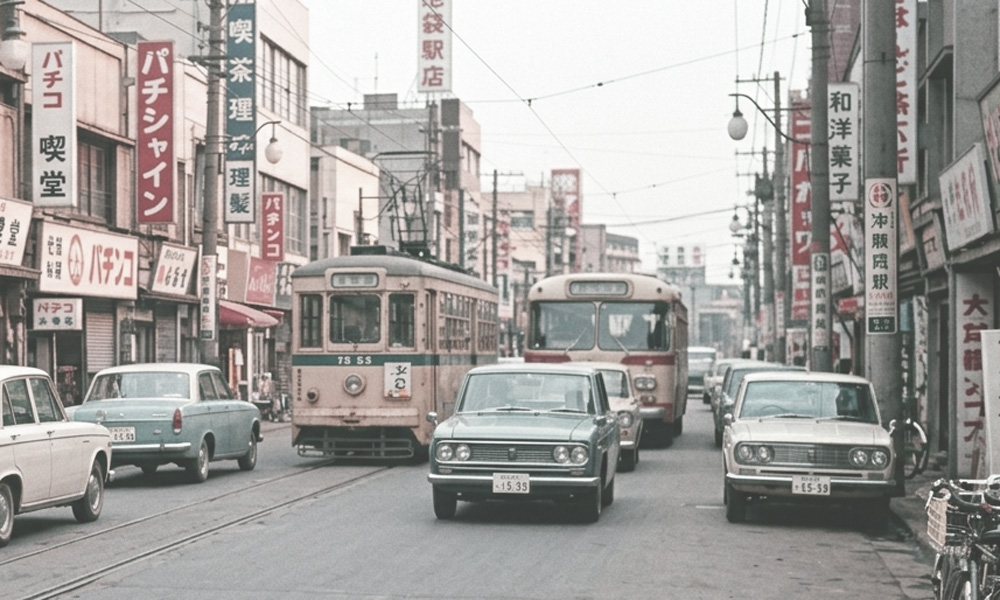
The year before, in 1964, Tokyo had hosted the Olympic Games. The Shinkansen bullet train had launched. The expressways had sliced through the city. The whole country had been electric with excitement, and the atmosphere had not yet fully cooled when spring arrived in 1965.
Japan was deep in what economists would later call its period of high economic growth — a stretch of roughly two decades when the country expanded at a pace that stunned the world. By the mid-1960s, black-and-white television sets were giving way to color; automobiles were multiplying in the streets; the rhythm of daily life was accelerating month by month.
That same autumn, in October 1965, the Izanagi Boom would begin — the longest postwar economic expansion Japan had seen at the time, stretching nearly five years. The country was running toward a future it had not yet fully imagined.
What the Young People Carried With Them
But speed was not the whole story. Beneath the optimism, the rapid industrialization was already scarking cracks — pollution, overcrowding, a growing unease among young people who wanted to question the direction society was headed.
The graduating students I faced that spring held both of these feelings at once: excitement about what lay ahead, and a quiet uncertainty about what kind of world they were stepping into. I could see it in the way they held their brushes during those final weeks. Confident in their strokes, but still searching for something.
The Spring I Sent Off My First Graduates
The Weight of Being Twenty-Five
I was around twenty-five at the time. What I felt was not the nervousness of being called “Teacher” — it was something heavier than that. It was the weight of responsibility for people who were about to leave.
In the world of shodo, graduation is something like the moment a character leaves the confines of the half-sheet of practice paper and steps onto a wider, unmarked surface. Everything the student has built through months and years of practice — the control of the brush, the sensitivity to negative space, the patience with imperfection — all of it now has to function without the structure of the lesson.
I kept thinking about what I could give them. Not a technique. Not a rule. Something they could carry without effort, something they might find useful in a quiet moment, years later.
Days Spent Searching for the Right Words
There was no shortage of candidates. Ichigo ichie — “treasure each encounter, for it will never recur.” Gasshō — dedicated effort. Fukinsei — the beauty of asymmetry, of imperfection embraced rather than corrected.
Each of these was true. None of them felt exactly right.
What I wanted was not an instruction, and not a reminder of difficulty. I wanted something that would follow them gently — something that could sit alongside them on ordinary days, not just on days of crisis or celebration. A phrase with warmth in it.
After several days of turning it over, I dipped my brush and sat down before the paper. I wrote Shōmon Raifuku.
Shōmon Raifuku — What Four Characters of Japanese Calligraphy Can Carry
The Deeper Meaning Behind the Phrase
Shōmon Raifuku (笑門来福) is the four-character form of the Japanese proverb Warau kado ni wa fuku kitaru — commonly translated as “Fortune comes to the home where laughter lives.”
The word mon (門) here does not mean a gate or doorway in the physical sense. It refers to the home, the family, the circle of people among whom one lives. And fuku (福) is happiness, good fortune — the kind of luck that is not random, but cultivated. The full meaning is something like: a family that keeps its laughter will naturally attract good things.
The phrase is said to have roots in fukuwarai, a traditional New Year’s game in which players are blindfolded and try to arrange the parts of a face — eyes, nose, mouth — correctly on an outline. The results are almost always absurd, and the laughter that follows is the whole point. From that laughter, the logic goes, flows fortune.
What struck me about this phrase was its honesty. It does not promise that life will be easy. It says, instead: whatever happens, stay open enough to laugh.
Why Shodo Delivers Words That Print Cannot
The same four characters printed in a textbook and written with a brush are not the same thing.
In shodo, as in all Japanese calligraphy, the physical trace of the artist is inseparable from the work. The pressure of the brush, the rhythm of the strokes, the breath between characters — all of this becomes part of the object itself. When I wrote Shōmon Raifuku for those graduates, what I was handing them was not only a phrase. It was a record of a specific moment of intention — my wish for them, made tangible.
Words spoken aloud disappear. Words written in ink remain. This is, I think, one of the oldest reasons human beings have cared about calligraphy across cultures and centuries. There is a particular kind of intimacy in receiving something made by hand: you know that someone sat, breathed, and chose.
That spring, I chose laughter. And I meant it.
Sixty Years On — Laughter Is Still the Strongest Medicine
Time has moved quickly. I have sent off many graduating students since 1965. The world they step into today looks nothing like the one those first students entered. The pace of change would be unrecognizable to my twenty-five-year-old self.
And yet Shōmon Raifuku has not aged. If anything, I find it more necessary now than it was then. The more complex and uncertain the landscape, the more that four-character phrase earns its place.
Every spring, I grind fresh ink. Every spring, I look for the words that will travel farthest, last longest, settle most quietly into a life. And every spring, I come back to the same understanding: a life with laughter in it is already a life that has prepared its welcome for good fortune.
The cherry blossoms do not last. But the impression of that season — the cold morning air, the smell of ink, the particular quality of light through the window — is something a brushstroke can hold. That is what japanese calligraphy has always done. Not to freeze time, but to mark it — to say: this moment mattered, and here is the shape of it.
deepens your connection to Japanese tradition.
Explore and purchase hand-selected Japanese calligraphy artworks:
https://calligraphyartwork.stores.jp/
コメント