Origins, Folk Beliefs, a Memory of 1970, Hidden Cherry Blossom Spots, and the Spirit of Shodo Japanese Calligraphy
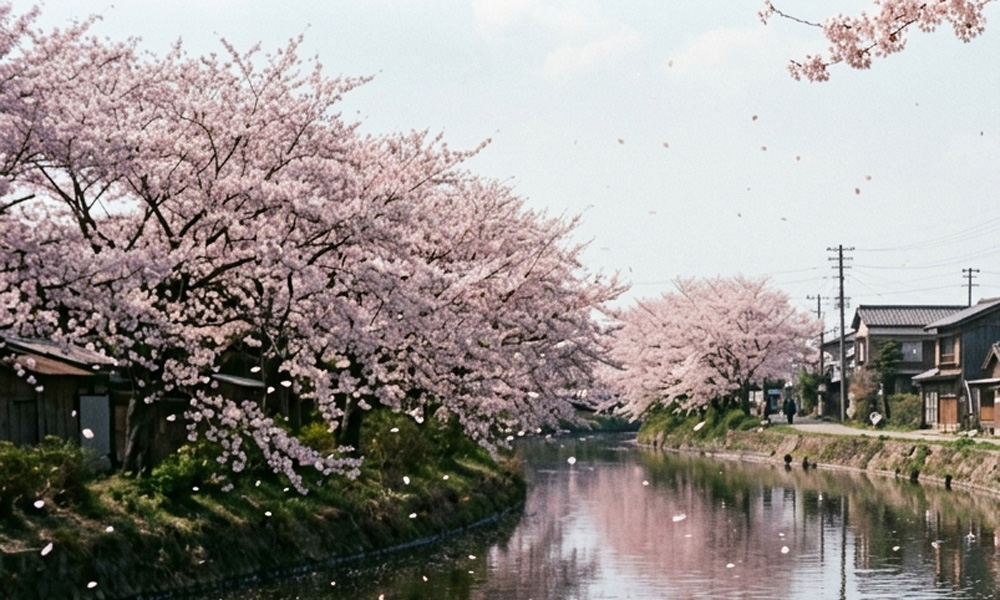
When people outside Japan think of spring, they often think of cherry blossoms first. That is understandable. Sakura is one of the most recognizable images in Japanese culture. But in Japan, cherry blossoms are not admired only because they are beautiful. They signal the turning of the season, awaken old memories, and bring together beginnings and farewells in a single landscape. That is why sakura is more than a flower. It is a feeling, a rhythm, and a way of seeing time.
For me, sakura has always been close to shodo Japanese calligraphy. A blossom opens, reaches fullness, and falls. A brushstroke begins, gathers force, and fades into silence. Both exist only for a moment, and yet both leave something lasting behind. This is one reason cherry blossoms remain so deeply rooted in Japan and culture.
The Origins of Sakura in Japan
Japan’s cherry blossom tradition began not with modern parks but with wild mountain cherries such as yamazakura. Over time, sakura became central to the Japanese imagination. By the Heian period, cherry blossoms had replaced plum blossoms as the dominant poetic image of spring. Later, cultivated varieties spread widely, and Somei Yoshino, the variety most people imagine today, became especially influential. According to Japan’s Ministry of Agriculture, Forestry and Fisheries, Somei Yoshino spread from the village of Somei near Edo in the late Edo period and was propagated through grafting, which is why trees across Japan are essentially clones of the same line.
The word sakura itself carries old layers of meaning. One traditional explanation connects sa to the rice-field deity who descends in spring, and kura to the seat where that deity rests. Another line of interpretation links the blossom to Konohanasakuya-hime, a deity associated with flowering and flourishing. Even if no single theory is final, these ideas show something important: from very early on, sakura was understood not only as a plant, but as a sign of renewal, abundance, and the arrival of a living season.
Folk Beliefs and the Meaning of Hanami
This is why I prefer to speak of folk belief rather than mere sightseeing. In older Japanese thought, cherry blossoms were not just there to be looked at. They marked the moment when life in the fields, villages, and homes began to move again. In agricultural belief, the blooming of sakura was tied to the timing of rice planting. The Ministry of Agriculture also explains hanami as something that once carried the meaning of welcoming and honoring the seasonal deity, with gatherings under the blossoms connected to prayers for a good harvest.
Even now, that feeling has not disappeared. Most people today do not consciously think about gods descending from the mountains. Yet when cherry blossoms bloom, people slow down. They look up. They speak more softly. They feel that a threshold has been crossed. New school years begin. New jobs begin. New relationships begin. Sakura still holds that power. It still tells people that time has turned.
That old current of feeling was still alive in the Japan I remember most clearly: the spring of 1970.
The Sakura I Remember in 1970
In 1970, cherry blossoms were not, for me, a tourist attraction. They were part of daily life. I saw them by the school gate, at the edge of the schoolyard, and along the road students walked each morning. The air was still cool, but the branches had changed. They were softer, brighter, as if the light itself had settled into them overnight.
I remember one small moment especially well. A classroom window was slightly open, and a single petal drifted in with the breeze. It landed on a student’s desk. The student picked it up quietly and slipped it into a notebook without saying a word. It was a very small moment, but I have never forgotten it. Sakura does not always stir people into loud emotion. Sometimes it touches the quietest part of the heart.
At lunchtime, students would gather near the corridor windows or at the edge of the grounds, talking about exams, club activities, graduation, jobs, and the future. Some laughed easily. Others looked unsettled. Spring in Japan has always carried both arrival and departure. That was true then, and it is true now.
At the time, I looked at cherry blossoms with the eyes of a biology teacher and also with the eyes of someone devoted to calligraphy. From a biological point of view, the process is clear: buds swell, flowers open, petals fall, leaves emerge. But from the point of view of a Japanese artist, sakura is never only a botanical event. The hesitation before blooming, the tension of full blossom, the sudden stillness of petals falling—these felt to me like the movement of the brush itself.
The towns of that time were also different. There was more noise, more closeness, more roughness in daily life. Shopping streets were lively. Neighbors were sometimes warm, sometimes difficult. People were friendly one day and irritated the next. Yet when sakura bloomed, everyone seemed to enter the same season together. The cherry blossoms of 1970 were not polished or staged. They were woven into ordinary life. That is why they remain with me so strongly.
Five Hidden Cherry Blossom Spots Across Japan
Because I first knew sakura through ordinary life rather than famous tourism, I am often drawn to places that still feel intimate. Here are five lesser-known cherry blossom spots in Japan that stand slightly apart from the most crowded classics. Official Japan travel sources highlight these places as quieter or lesser-known options, and some have also become favorites among photographers and social media users for exactly that reason.
- Tsuruga Castle, Fukushima
A striking blend of castle architecture and sakura, with around 1,000 cherry trees and evening illuminations in spring. It has the classic beauty of “castle and blossom,” but feels calmer than the most internationally famous spots. - Kita Asaba Sakura Avenue, Saitama
A peaceful 1.2-kilometer cherry blossom walkway lined with about 200 trees along the Oppe River. It feels less like a tourist destination and more like spring unfolding inside everyday neighborhood life. - Kodaira Green Road, Tokyo
A quieter way to experience sakura in Tokyo, with tree-lined walking routes that let you feel the season at street level rather than inside a crowded landmark. Official travel features describe it as one of Tokyo’s hidden sakura spots. - Bungo-Nakagawa Station Area, Oita
A favorite for photographers, where trains appear to move through a tunnel of blossoms. It offers a sense of motion and story that is different from static park viewing. - Kirishima Jingu Shrine, Kagoshima
A quiet sakura setting at the foot of the Kirishima Mountains, where shrine architecture, nature, and spring bloom come together. It feels closer to prayer than to a party.
What matters to me is not only how many trees a place has. The true power of sakura lies in how it meets a landscape, a history, and the pace of human life. A mountain shrine, a riverside path, a station platform, a school gate—each reveals a different face of the same season.
Sakura and Shodo Japanese Calligraphy
That is why the sakura of my memory and the sakura of these hidden places do not feel separate to me. Both are more than scenery. Both gather atmosphere, memory, and time into visible form. And this is where sakura meets shodo Japanese calligraphy most naturally.
Shodo is not simply the art of writing beautiful characters. Official Japanese tourism materials describe it as a traditional art requiring precise movement and deep attention, and also as a practice through which expression, concentration, and inner awareness become visible. Brush, ink, and paper are only the surface. What matters is the life inside the stroke.
Cherry blossoms work the same way. Full bloom is not the whole story. The tension of the unopened bud, the softness of first bloom, the brightness of fullness, and the silence of falling petals all belong to sakura. In shodo, a line begins, moves, pauses, and disappears. In sumi e as well, what is left unpainted matters as much as what is shown. This deep respect for space, timing, and suggestion is one of the places where Japanese culture reveals its character most clearly.
When I write the character for sakura, I do not try to describe petals literally. I try to place into that single character the petal that drifted into the classroom in 1970, the stillness near the school gate, the uneasy faces of students standing between departure and beginning, and the spring light spreading over a busy town. Because of that, sakura is never only a flower to me. It is time made visible.
Sometimes the spread of ink looks like mist. Sometimes the trembling of a fine line feels like a branch moving in the wind. In such moments, I feel that shodo Japanese calligraphy and sakura are looking toward the same truth. Both try to hold what cannot be held for long. Both honor the beauty of what passes.
That may be why sakura still moves the Japanese heart so deeply. Not because it is merely pretty, but because it reflects impermanence, memory, and the emotions that remain just beyond words.
deepens your connection to Japanese tradition.
Explore and purchase hand-selected Japanese calligraphy artworks:
https://calligraphyartwork.stores.jp/
コメント