In Japan, graduation is not simply a school event.
It marks the end of one stretch of time and the beginning of another. It is a turning point that carries pride, unease, gratitude, and a quiet sense of loss all at once.
Why, then, are graduation memories in Japan so often intertwined with cherry blossoms?
I have thought about this question every spring for many years. For me, spring was never just a season. As a biology teacher, I watched the changes in plants, light, air, and temperature. At the same time, as a calligraphy teacher, I also watched how human feelings took shape through the brush.
When I look back especially on the springs of the 1970s, graduation, cherry blossoms, and calligraphy do not seem like separate things at all.
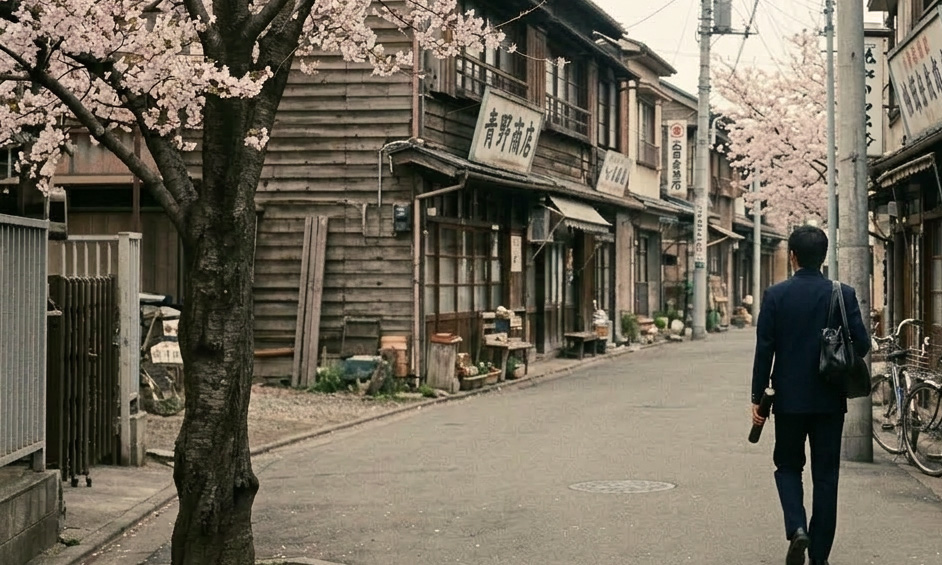
People today sometimes remember that era as neat and nostalgic, but the real Japan of the 1970s was rougher, noisier, and far more crowded with human presence. Streets were busy, downtown neighborhoods were full of energy, and relationships between neighbors were often too close for comfort. People got along, then argued, then saw each other again the next day. Graduation ceremonies, cherry blossoms, and calligraphy all existed on top of that raw, restless reality.
That is why the springtime of those years still feels so distinctive to me.
In March, Japan Held a Kind of Farewell That Could Not Be Reduced to Something Beautiful
There is, I believe, a reason why graduation in Japan takes place in March.
March is a season that is neither fully winter nor fully spring. The cold still lingers in the morning air, yet the sunlight has already begun to soften. The wind changes. People begin to feel unsettled, as if something is quietly shifting beneath the surface.
From the viewpoint of a biology teacher, this in-between time is especially meaningful.
Plants do not suddenly become spring overnight. They respond to accumulated cold, to changes in light, to invisible preparation over time. Only then do buds begin to move. Human transitions are much the same. Graduation is not meaningful only on the day of the ceremony. The change begins earlier, in ways that are not immediately visible.
That could be felt in the classroom as well.
Students in March still looked like themselves, yet something had already changed. Their laughter was slightly different. Their silences grew longer. The way they stood near their friends, or looked at their teachers, was no longer the same. Even on ordinary days, the ordinary had already begun to disappear. A teacher can sense that.
And in the Japan of the 1970s, that atmosphere felt even more immediate.
Schools and towns were far less polished than they are now. Hallways, schoolyards, voices, and daily routines were rougher and more chaotic. Shopping streets were loud. Cars seemed louder too. Children were more physical, more direct, and sometimes more unruly. Neighborhood ties were strong, but that did not mean they were always warm. People helped each other, but they also clashed. Emotions were not neatly hidden away.
Because everyday life was so crowded and uneven, graduation was not merely an event.
In the midst of noisy routines, one day arrived when people dressed properly, straightened their posture, chose their words carefully, and faced parting directly. Daily life was rough, which made that moment of order and stillness feel all the more powerful.
Cherry Blossoms Did Not Float Above Life; They Bloomed Over It
Outside Japan, cherry blossoms are often seen as a symbol of refined Japanese beauty.
That is not wrong, but in reality cherry blossoms in Japan have always been much closer to daily life than many imagine. Especially in the 1970s, they were not confined to carefully designed scenic spots. They bloomed above the noise of ordinary life.
Cherry blossoms beyond the hum of the street.
Petals falling onto slightly dusty roads.
A pale pink line visible beyond a lively shopping district.
A cherry tree standing at the edge of a noisy schoolyard.
That was the landscape.
Not a silent picture-postcard scene, but spring arriving in the middle of daily commotion.
From the perspective of a biology teacher, cherry blossoms are not merely symbolic.
Flowers do not bloom for human sentiment. They bloom according to temperature, sunlight, and the internal rhythm of the tree itself. That indifference gives them their force. Cherry blossoms do not adjust themselves to human emotion, and precisely for that reason they align with it so deeply.
Graduation and cherry blossoms are linked not because they simply look beautiful together.
School life, too, feels as though it will continue forever while one is living it, yet it ends when the season turns. Friends, classrooms, small routines, and familiar voices all become memories before one fully notices it. Cherry blossoms express that truth without explanation.
People often say that cherry blossoms are beautiful because they fall.
That is a beautiful phrase, but the feeling itself is even more concrete.
We are vulnerable to things that do not remain.
We are drawn to time we cannot return to.
Graduation and cherry blossoms overlap in Japan because that feeling has long been woven into everyday life.
As a Calligraphy Teacher, I Felt That Graduation Was the Season When Words Grew Heavy
In the 1970s, I taught in ordinary classrooms while also teaching calligraphy.
Because I stood in both worlds, I came to understand how spring gives unusual weight to words.
Words spoken or written before graduation are not the same as words used at any other time.
Even a simple word like “thank you” or “hope” becomes difficult to handle lightly at the end of March. By then, those words contain accumulated time.
Calligraphy is not merely the skill of making characters look beautiful.
The beginning of a stroke, the pause, the sweep, the pressure, the blur of ink, the surrounding blank space—all of these reveal breath, hesitation, determination, and feeling. At moments like graduation, one can see very clearly what a person is trying to entrust to language.
Take the single character for “path,” for example.
It is not enough to write it in a balanced form.
Is there resolve in it?
Is there uncertainty?
Is there longing for what is being left behind?
All of that may appear in a single vertical line or in the final sweep of the brush.
In the 1970s, handwritten words carried far more weight than they do today.
Printed text did not yet dominate every part of life. The words written by hand—on classroom displays, in farewell messages, in ceremonial remarks, in group notes—felt closer to the person who wrote them. One’s attitude showed itself in one’s handwriting. In a daily world that could be rough and disorderly, writing carefully could suddenly reveal character. That contrast, too, belonged to that era.
Life outside was noisy. People were blunt. Days were crowded and messy.
That is exactly why sitting before a sheet of paper, grinding ink, and gathering one’s mind into a single character felt so important.
The more unsettled the outside world was, the deeper the stillness on the page became.
That is what I remember most clearly from teaching both in the classroom and in calligraphy during the 1970s.
Japan in the 1970s Was Not Simply Warm, and Not Simply Strict
I do not believe that period should be romanticized.
It is true that people lived closer to one another, but closeness did not always mean kindness.
Because people knew each other too well, there was often little restraint.
Downtown neighborhoods were lively, but they could also be coarse.
Adults and children alike were more direct than they are now, sometimes to the point of roughness.
Schools were not separate from that society.
Students carried the mood of the town into the classroom with them. What they had was not merely energy in the cheerful sense, but something more raw and immediate. They could be careless, stubborn, even unruly, yet there was also warmth in them. They were not polished children. They were social beings growing inside a society that was itself unfinished and noisy.
That is why graduation ceremonies mattered so much.
Against the roughness of daily life, everyone understood: this is a day of passage.
You dressed properly.
You stood in line.
You bowed.
When your name was called, you answered.
Only by placing oneself inside those forms did the meaning of parting begin to come into focus.
I believe that was part of what gave graduation ceremonies in those years their weight.
A sudden stillness in the middle of noisy life.
A brief straightening of the back in the middle of ordinary human disorder.
That contrast turned graduation into something more than a school ritual. It made it unforgettable.
Graduation, Cherry Blossoms, and Calligraphy Express a Japanese Sense of Time
Graduation, cherry blossoms, and calligraphy belong together in Japan because all three are linked to the same impulse: the wish to hold something in the heart even as it passes away.
Graduation is where one becomes aware that a shared stretch of time is ending.
Cherry blossoms show, before our eyes, that beauty does not remain.
Calligraphy is an attempt to preserve the feeling of a single moment through line and space.
To me, the fact that these three meet in the same season is deeply Japanese.
And I do not mean that in an abstract or idealized sense.
I mean that even amid crowded streets, the smell of daily life, difficult neighbors, noisy children, and all the roughness of ordinary existence, people still paused to honor a turning point, looked up at blossoms, and left their feelings behind in brush-written words. There is a quiet strength in that.
As a biology teacher, I learned that spring is not simply a beautiful season. It is a season of change.
As a calligraphy teacher, I learned that graduation is not simply a farewell. It is the season when words take on real weight.
And from the lived reality of the 1970s, I learned something else: that spring was rougher, louder, and more human than memory sometimes allows.
That is precisely why the cherry blossoms seemed beautiful, why farewell words felt so deep, and why a single character written with a brush could remain unforgettable.
Flowers bloom, and then they fall.
Students leave the classroom and go on to their own lives.
The noise of the town continues, and the seasons return.
Yet a word written in brush and ink can quietly preserve the feeling that truly existed in that spring.
That is why, when graduation season comes, I think of calligraphy when I look at cherry blossoms.
Not only because the Japanese spring is beautiful, but because it reminds me that even in a rough and imperfect world, people have always tried to honor life’s turning points with care.
Deepen your connection to Japanese tradition.
Explore original calligraphy works inspired by Japanese aesthetics and seasonal feeling:
https://calligraphyartwork.stores.jp/
コメント