Regional cuisine in Japan is a small cultural encyclopedia on a plate—condensing local climate, history, and seasonal rituals. This column proposes a new, travel-friendly way for English-speaking admirers of Japan to enjoy those flavors as lived experience and then convert their stories into a portable cultural asset through Japanese Calligraphy. Built on public, primary sources (MAFF/UNESCO), it highlights news value, originality, and social relevance in clear, simple language.
What “regional cuisine” means—eating a place’s memory
MAFF’s “Our Regional Cuisines” project systematizes each region’s dishes with origin stories, historical notes, recipes, and local context, aiming at intergenerational transmission and practical use at home and in education. Regional cuisine also functions as ritual food, eaten with wishes and meanings across annual events and seasons.
SEO co-occurrence terms: region, climate, ritual food, history, recipe, transmission, local production for local consumption, season, preserved food, fermentation, local resources, food education.
Global context—Washoku and intangible cultural heritage
Washoku (traditional dietary cultures of Japan) was inscribed on UNESCO’s Representative List in 2013 as a social practice tied to seasonal and annual events. Regional dishes are its local crystallizations. In 2024, the traditional knowledge and skills of sake-making with koji mold also entered the list, renewing global attention to the craft that links food with place.
Example from Fukuoka: what Chikuzen-ni (Gameni) tells us
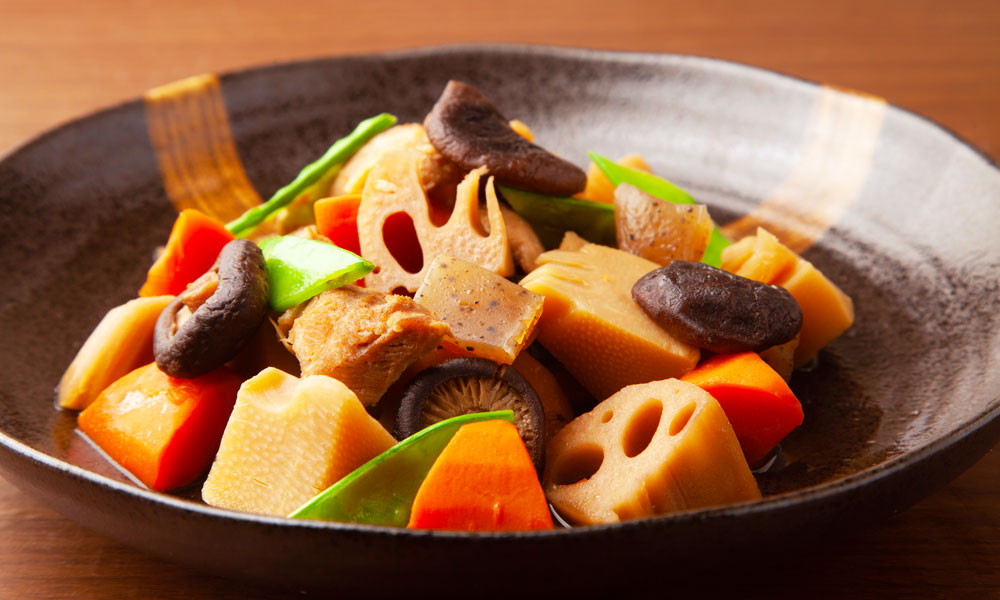
Gameni—widely known nationwide as Chikuzen-ni—is a Fukuoka classic. The dish gathers chicken, root vegetables, and konnyaku, first sautéed to build aroma and then gently simmered so the flavors permeate. Locally, it also appears as ritual food for New Year and festivals. The naming and origin have several theories; what endures is the idea of bringing ingredients together and letting time do the work.
Signature regional dish: Chikuzen-ni (Gameni) — Basic Home Recipe (serves 4–5)
Ingredients
- Boneless chicken thighs 250–300 g (9–10.5 oz)
- Potatoes or taro 300 g (≈ 2 cups chopped)
- Carrot 80 g (≈ 2/3 cup chunks)
- Bamboo shoot (parboiled) 100 g (≈ 1 cup)
- Dried shiitake 10 g (3–4 caps), rehydrated (reserve soaking liquid)
- Green beans 20 g (a small handful), blanched
- Konnyaku 100 g (≈ 1 cup torn pieces), parboiled
- Dashi 400 ml (1⅔ cups) + shiitake soaking liquid as part of the dashi
- Seasoning A: soy sauce 25–30 ml (1½–2 tbsp), salt 4–5 g (¾–1 tsp), mirin 30 ml (2 tbsp), sugar 20–30 g (1½–2½ tbsp)
- Neutral oil 1–2 tbsp
- Julienned ginger 15 g (for finishing)
Prep
- Rehydrate shiitake; keep the soaking liquid for the broth. Tear konnyaku and parboil.
- Cut chicken into bite-size pieces. Cut vegetables into even, chunky pieces.
Steps
- Heat oil. Lightly sauté chicken, then vegetables to coat them in fat.
- Add dashi (plus shiitake liquid). Stir in Seasoning A.
- Simmer gently until vegetables are tender and the sauce slightly thickens and glazes the ingredients.
- Add green beans at the end for color. Top with ginger. Rest 5–10 minutes off heat to let flavors settle.
Plating & aesthetic cues (Japanese culture)
Use a bowl with ample negative space. Compose contrasts—the curve of shiitake caps, the geometry of lotus root when used regionally, the straight lines of green beans. This quiet balance mirrors the sense of ma (meaningful space) also treasured in Japanese Calligraphy.
Why “regional cuisine × calligraphy” works—turn flavor into a tangible memory
Behind every dish are place names, rituals, techniques, and seasonal words.
- Menus and shop curtains written in brush script already visualize culinary stories.
- To carry the memory home, commission or collect a small Japanese Calligraphy piece themed on the dish name, the place, or a seasonal word (kigo).
- Partner with a Japanese artist (calligrapher) to create compact works (half-sheet size), such as a “ritual-food calendar” for the region. It strengthens local branding while preserving cultural context.
Editorial stance: we value craft, continuity, and respectful modernization—connecting traditional knowledge to contemporary life.
Experience design proposal: Taste & Ink (tasting event × live calligraphy)
- Story briefing: climate, festival ties, timing in the year
- Aesthetics of the table: vessel, composition, and the power of empty space
- Live calligraphy: one-character or short phrases for dish/place/seasonal word
- Art for good: offer small works for purchase and donate a share to cultural preservation
This lets travelers eat → learn → bring home. It reframes Japanese Calligraphy / Japanese culture as an experiential collectible rather than just a souvenir.
How to practice—search smart, deepen on site, preserve with art
- Start with MAFF’s public database to check the origin, history, and recipe of the dish you plan to try.
- Time your visit to seasonal or ritual contexts when possible.
- Close the loop by collecting a Japanese artist’s brush work that encodes the flavor narrative into lasting form.
Conclusion
Regional cuisine is a living culture rooted in nature, history, and ritual. UNESCO’s recognition of Washoku (2013) and sake-making with koji (2024) shows sustained global interest in the craft that binds food to place. Japanese Calligraphy becomes the medium that preserves those stories in tangible form. By uniting taste and ink, you nurture both cultural continuity and a meaningful purchase experience.
Sources (primary/public)
- MAFF “Our Regional Cuisines” (overview; dish pages including Gameni/Chikuzen-ni)
- UNESCO: Washoku, traditional dietary cultures of the Japanese (2013)
- UNESCO: Traditional knowledge and skills of sake-making with koji mold in Japan (2024)
deepens your connection to Japanese tradition.
Explore and purchase hand-selected Japanese calligraphy artworks:
https://calligraphyartwork.stores.jp/

コメント