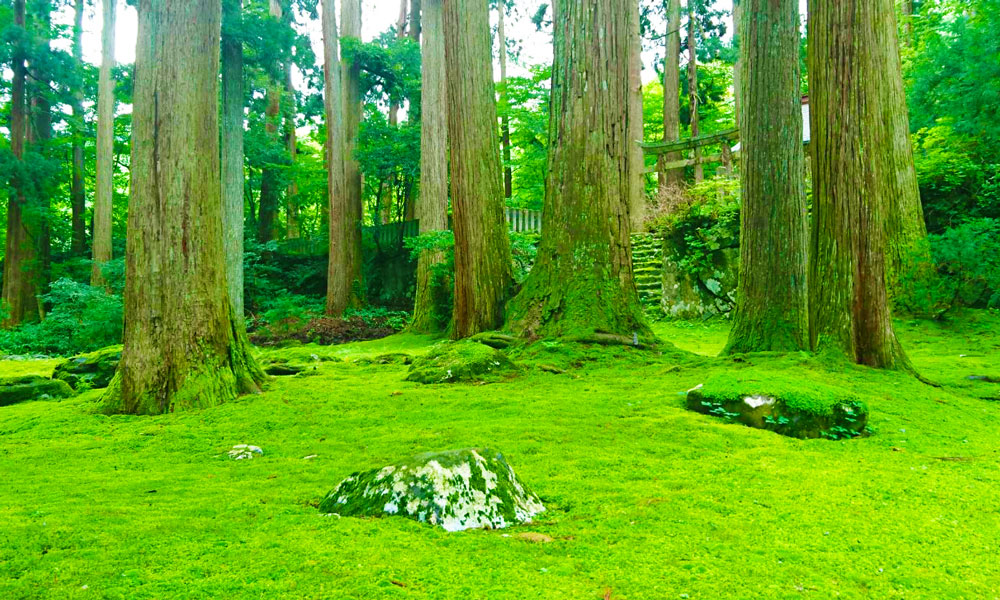
Moss absorbs light softly and quiets the edges of stone and wood. It embodies wabi-sabi and ma (meaningful space). Those same values animate Japanese Calligraphy—ink on washi guided by the breath of the fude brush. This column highlights moss destinations you can actually visit and ways to choose calligraphy that carries the experience home—designed for readers of Japanese culture who value work by a Japanese artist.
Where to go — Essential moss sites (practical guide)
1) Kyoto: Saihō-ji (Kokedera / “Moss Temple”)
A World Heritage garden famed for dense carpets of moss and a pond-stroll layout. Advance reservations are required. Expect a hushed atmosphere where sound seems to fade.
2) Fukui: Heisenji Hakusan Shrine (heisenji.jp)
A sanctuary of stone-paved approaches under cedar trees, many areas richly covered in moss. The grounds rest on remains of a historic religious center tied to Mount Hakusan worship. Clear on-site guidance makes it easy to add to an itinerary.
3) Kagoshima: Shiratani Unsuikyo (Yakushima)
The celebrated “mossy forest.” Trails wind through granite boulders, ferns, and ancient cedars, with green tones that shift dramatically after rain.
The heart of moss culture: wabi-sabi and “ma”
Moss gardens build beauty in the opposite direction of spectacle. Soft greens accept the “lines” of stones, while dew and dappled light create subtle shadows. On paper, this translates to sumi gradations, the ease of the brush’s start and lift, and the character of the paper’s fibers. The tempi of kaisho, gyōsho, sōsho align naturally with the unhurried time of a moss garden. The one-stroke clarity of ensō and the calm of Zen fit the theme perfectly.
Tea-garden roji and moss
The roji path to a teahouse slows the mind to the pace of tea. Stepping stones, a tsukubai water basin, and a stone lantern—moss gathers around these and quietly guides stride and gaze. Apply the same approach to viewing calligraphy: lower the eyes, focus on a single character, then breathe with the space around it.
How to look: what moss teaches about seeing calligraphy
- Tonal depth — Watch the boundary between dark and light ink; like mossy shade, gentle transitions add dimension.
- Dry brush — Slightly dry strokes echo the texture of spores and stone.
- Space (ma) — The courage not to fill; empty space absorbs sound and leaves resonance. The ensō shows this at its simplest.
For collectors (Japanese culture × Japanese Calligraphy)
- One-character works × moss-tone matting: themes like “Calm / Clear / Echo.” Deep-green mats and non-glare glazing help the piece settle into the room.
- Ensō × stone texture: a single breath with a bold brush; choose a paper whose surface suggests ground.
- Kana miniatures × morning dew: fine brush + light ink layers, with small whites that suggest points of light.
- Materials: washi (kōzo) and mid-tone sumi flatter green surroundings. Finish with a hand-carved tenkoku seal—one warm ember in a quiet field.
- Placement: set a moss bonsai or kokedama a bit lower; hang the calligraphy slightly above eye level so the vertical movement of the gaze creates a felt ma.
From experience to ownership — a buying guide (the Japanese artist’s view)
- Choose a theme: a word that anchors your trip (e.g., Calm / Wind / Light).
- Select style and size: pick kaisho, gyōsho, or sōsho and dimensions suited to the space.
- Creation: premium washi, layered sumi tones, and a tenkoku seal to complete the work.
- Framing & install: moss-tone mats or natural wood frames; tune height and lighting for quiet presence.
Bring home more than photos. Bring home the stroke, the silence, and the moment.
deepens your connection to Japanese tradition.
Explore and purchase hand-selected Japanese calligraphy artworks:
https://calligraphyartwork.stores.jp/


コメント