Around the world, people are discovering shodo Japanese calligraphy and sumi-e ink painting as elegant doorways into Japanese culture. In Japan, a growing group of contemporary Japanese artists is taking this one step further: they are redesigning how we eat. By weaving calligraphy, Zen, and cuisine together in restaurants, retreats, and experiential cafés, they are turning ordinary meals into quiet, memorable “Zen dining experiences.”
For travelers and collectors who are curious about Japan and culture, these experiments offer something rare: a chance to taste Japanese food, feel the atmosphere of a Zen temple, and live inside a piece of calligraphy—all at the same time.
When a Tasting Menu Becomes a Scroll of Shodo Japanese Calligraphy
One powerful trend appears in luxury hotel restaurants, where chefs and calligraphers co-create special menus. At places such as Park Hyatt Tokyo and Palace Hotel Tokyo, chefs have collaborated with well-known Japanese artists to design dinners where every course is linked to a character or phrase written in shodo Japanese calligraphy.
In some collaborations, calligraphers carve or glaze characters like “mu” (emptiness), “wa” (harmony), or “nichinichikorekojitsu” (“every day is a good day”) directly onto ceramic plates and bowls. Seasonal dishes are then plated on top of these characters. As guests progress through the meal, they discover parts of each character as they eat, almost like reading a hidden scroll. A plate might first appear as an abstract sumi-e design. Only when the food is gone does the full calligraphic form reveal itself.
This is more than decoration. The character becomes a theme for the course. While you taste a simple piece of perfectly grilled fish and seasonal vegetables, the word “wa” underneath quietly suggests questions: Where do I feel harmony in this dish? In the balance of salt and acidity? In the contrast between crunchy and soft? Eating becomes an act of reflection.
In these spaces, shodo Japanese calligraphy and fine dining merge into one performance. The chef controls time, taste, and temperature. The Japanese artist controls rhythm, balance, and visual tension on the plate. The guest experiences the whole sequence like reading a long vertical scroll with the senses, instead of the eyes alone.
Dining Rooms Shaped by a Single Character of Zen
Other projects start not from the food, but from the room. In some contemporary restaurants, the entire interior is built around a single large piece of calligraphy or a wall of sumi-e.
Imagine entering a dining room where the walls are raw wood and stone, the lighting is soft, and one bold black character fills the main wall. The character might mean “hito” (person), suggesting the bond between people and nature, or it might be a Zen phrase about the beauty of ordinary days. You sit, and throughout the meal your eyes return, again and again, to that one brushstroke.
Interior-focused galleries and studios in Tokyo now specialize in this kind of work. They create large-scale sumi-e and shodo pieces specifically for hotels, ryokan, and restaurants. The goal is not just to hang a “Japanese-style painting,” but to let the energy of the brush define the mood of the entire space. The empty margins of the piece echo the empty areas of the wall. Together, they create the sense of ma—meaningful emptiness—that is central to Japanese culture.
In such spaces, the Japanese artist functions almost like a lighting designer or architect. The calligraphy determines how guests feel as they lift their chopsticks, how quietly they speak, how long they linger after dessert. Eating becomes a way to inhabit a living sumi-e painting.
Zen Retreats Where You Practice “Writing Meditation” and “Eating Meditation”
If the hotels and restaurants are the city version of this trend, Zen retreats are its mountain counterpart. On islands like Awaji and in other quiet regions of Japan, specialized Zen wellness facilities combine yoga, zazen, and calligraphy with a style of cuisine inspired by traditional Buddhist temple food.
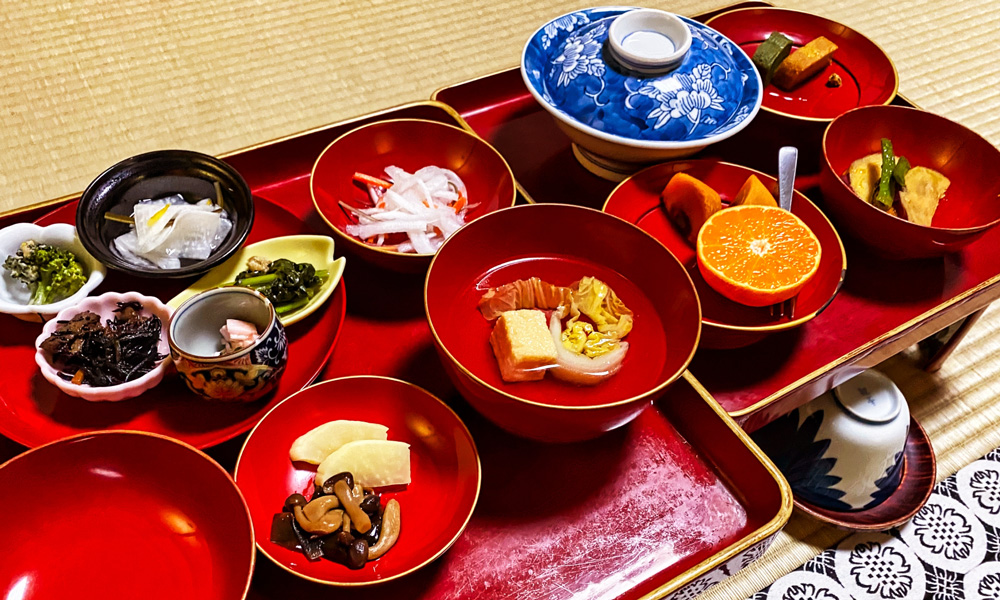
A typical day at such a retreat might include walking meditation on an open-air deck, a session of “Zen calligraphy” where you trace sutras or short poems with a brush, and then a plant-forward dinner that avoids meat, refined sugar, and heavy oils. The meal is served in carefully chosen bowls and trays, sometimes with small calligraphic motifs on the lids or chopstick rests. Guests are encouraged to eat slowly, in silence, paying attention to each bite and each breath.
Here, shodo Japanese calligraphy is not just something you look at. It is something you do with your own hand. The moment when ink touches paper becomes a mirror for the mind: is your line shaky, rushed, hesitant, or steady and calm? Later, when you lift a piece of simmered daikon or taste a spoonful of miso soup, you notice the same patterns in how you chew and swallow.
This is where sumi-e, Japanese calligraphy, and food reveal their shared DNA. All three are time-based arts. You cannot rewind the stroke of a brush or the first bite of a dish. Once you move, the moment is gone. That is exactly why Zen practice treats each stroke and each mouthful as a complete universe.
Experiential Cafés as Playful Gateways into Japanese Culture
Not every Zen dining experience has to be serious or solemn. In districts like Omotesando and Harajuku, experiential cafés are emerging as playful gateways into Japan and culture for younger visitors and global tourists.
Picture a café themed around heroes of Japanese history—samurai, shogun, or legendary artisans. On the first floor, you can order matcha lattes and wagashi sweets decorated with simple sumi-e-style motifs: a dragon, a wave, a single bold character. On the upper floor, you can book short workshops in shodo, tea ceremony, or even sword-handling basics. The walls are lined with works by contemporary Japanese artists who mix graffiti influences with traditional calligraphy, creating dynamic black-and-white pieces that photograph beautifully for social media.
In these spaces, sumi e and Japanese calligraphy are used like a visual language that needs no translation. Even visitors who do not read kanji can feel the speed of the stroke, the contrast between thick and thin lines, and the silence in the white space. They can sip a seasonal parfait, post a photo, and still catch a glimpse of the deeper currents of Japanese culture flowing underneath.
For many people, this kind of casual, Instagram-ready encounter is their first step toward more serious experiences: visiting a Zen temple, commissioning a custom work from a Japanese artist, or starting their own practice of shodo at home.
From “Filling Your Stomach” to “Reclaiming Your Senses”
Looking across these examples—hotel collaborations, calligraphy-shaped interiors, Zen retreats, and experiential cafés—a pattern appears. In each case, “eating” is being redefined.
A typical meal answers the question, “Am I full yet?” A Zen-inspired dining experience, guided by shodo and sumi-e, asks more interesting questions:
How does this dish change the silence in the room?
What emotion does this single character on the plate awaken in me?
Do I leave this table more scattered—or more centered—than when I sat down?
This shift is exactly where shodo Japanese calligraphy and food meet. Both ask you to slow down and pay attention. Both are built on discipline and years of practice, yet aim at a feeling of natural ease. Both understand that what you do not add—the stroke you choose not to draw, the garnish you choose not to use—can be as important as what you include.
For discerning travelers and collectors, seeking real depth in Japan and culture, following this wave of calligraphy-centered dining is one of the most rewarding paths you can take. It allows you to support Japanese artists directly, discover new layers of Japanese cuisine, and—most importantly—use every meal as a chance to return to yourself.
deepens your connection to Japanese tradition.
Explore and purchase hand-selected Japanese calligraphy artworks:
https://calligraphyartwork.stores.jp/

コメント