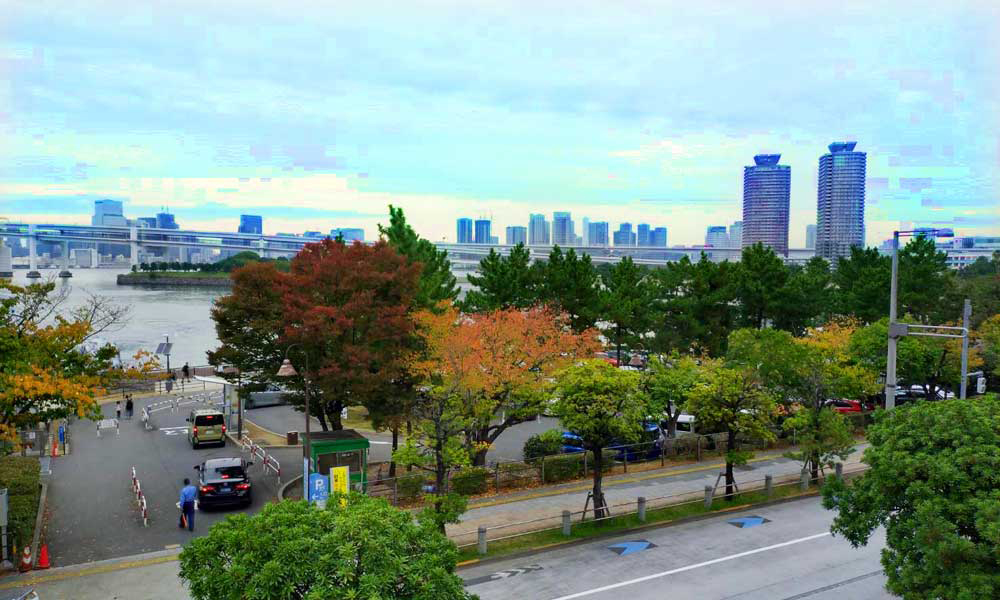
An autumn row of pines, the still sea, and Rainbow Bridge stretching across the skyline: this single photograph from Odaiba contains every backbone a line can have—horizontal, vertical, diagonal, and curved. Treat the image as your first workbook. By tracing these directions with your eyes, you start to feel how a line stabilizes, how space breathes, and how an urban rhythm can translate to the brush.
What is Shodo (Japanese Calligraphy)?—Japanese culture in a living practice
Shodo is the art of writing with a brush (fude) and sumi ink to express kanji and kana with clarity and poise. It grew from Chinese calligraphy yet took on a distinctly Japanese sensibility through the development of kana, the importance of empty space, and a ritual pace that favors presence over speed. In modern Japan it remains part of everyday culture, taught in schools and continued at home, temples, and studios.
The Odaiba Method—shodo japanese calligraphy through urban line design
Look again at the photograph. The sea gives you a perfect horizon; it is the measure for your horizontal strokes. The bridge towers stand with quiet weight; they teach the vertical stroke to begin decisively and descend without wobble. Taut cables show how a fine diagonal should hold tension rather than fray, and the gentle arch suggests how a curved stroke needs breath and a subtle lift at the end. When you map these urban lines into your hand, your writing stops fighting the page. It starts listening to it.
Tools for Shodo—fude, sumi ink, suzuri, and washi in Japanese calligraphy
A single medium brush and bottled sumi ink will remove friction at the start. An inkstone (suzuri) or a small ceramic dish helps you tune moisture, and a stack of washi lets you learn how fibers drink the ink. India ink can write a strong black, but many formulas resist water and create a different feel in overlaps; sumi rewards you with layered tones and a softer “breath” in the paper. Begin simple, then step up to an ink stick when you want to shape the black to your taste.
Kaisho, Gyosho, Sosho—the core scripts every Japanese artist studies
Most learners progress from Kaisho (standard) to Gyosho (semi-cursive) and then to Sosho (cursive). Kaisho clarifies structure; Gyosho trains flow and connected rhythm; Sosho compresses form into suggestion. Keeping this order protects the spine of each character even as your expression loosens.
The Eight Principles of Yong—linking Japan and culture through daily anchors
Calligraphers condense the essentials into one character, 永 (“eternity”). Its eight strokes rehearse all the typical beginnings, movements, and endings you will meet elsewhere. Write 永 at the start of each session while recalling the Odaiba scene—horizon for the horizontal, tower for the vertical, cable for the diagonal, arch for the curve—and you will feel landscape and handwriting merge into one habit.
A ten-minute routine and a seven-day starter map—shodo japanese calligraphy you can actually keep
Give yourself ten quiet minutes. First, study the photo and let your breathing slow until the horizon steadies in your mind. Then write 永 a few times, not to finish a piece but to calibrate pressure and speed. Close by finishing a single character—“橋” (bridge) or “縁” (connection)—and design the surrounding space so air can pass through it. Repeat this rhythm for a week. Early days focus on stable horizontals; midweek, you deepen the verticals; by the weekend, your diagonals hold tension and your curves land softly. You are not chasing perfection. You are learning to place a line that feels inevitable.
Conclusion—Japanese culture, Japanese artist, and the city beneath your hand
A photograph from Tokyo can be more than scenery; it can be a teacher. With minimal tools, a repeatable routine, and the city’s own lines as guides, Shodo becomes a daily practice that fits modern life. Begin with the horizon; let the tower steady your arm; carry the cable’s firmness into a diagonal; allow the arch to round your breath. In that sequence, a character is not just written. It is lived.
deepens your connection to Japanese tradition.
Explore and purchase hand-selected Japanese calligraphy artworks:
https://calligraphyartwork.stores.jp/


コメント