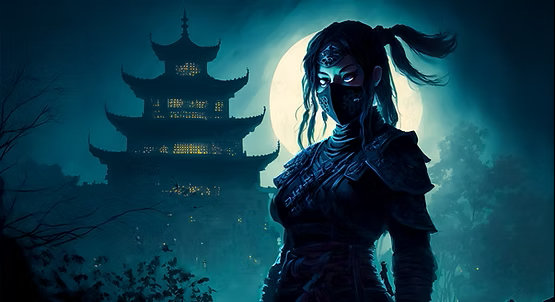
When people hear the word “ninja,” they often imagine throwing stars, cloaks of invisibility, or daring leaps across rooftops. But in reality, the true strength of ninjas lay not only in combat but in intelligence gathering. They skillfully used Japanese Calligraphy, a core part of Japanese Culture, as a “weapon” for information warfare.
On the surface, their letters and hanging scrolls looked refined and elegant. Yet hidden within those graceful brushstrokes were secret messages, known only to those who knew how to uncover them. This was a fusion of art and strategy unique to Japan.
The Role of Japanese Calligraphy in Ninja Intelligence Work
To pass sensitive information safely, ninjas developed special codes and ciphers. One well-documented method was called Goshikimai (“Five-Colored Rice”), where grains of rice dyed in white, blue, red, yellow, and black were arranged in specific patterns to convey messages .
For more complex communication, ninjas used the Shinobi Iroha code. This cipher assigned each of the 47 Iroha syllables (plus “n”) to one of seven radicals (wood, fire, earth, metal, water, person, body) and paired them with seven colors (blue, yellow, red, white, black, purple). This system cleverly incorporated the aesthetic and structural principles of Japanese Calligraphy .
Advanced Ciphers in Military and Ninja Manuals
Research from Mie University shows that historical Japanese military and ninja manuals describe various cipher techniques, some originating from the Chinese military classic Liu Tao (“Six Secret Teachings”). These included “hidden characters” and “hidden writing,” but such methods alone were relatively weak.A more secure technique—coordinate-based substitution ciphers—appeared in the mid-17th century. This method, documented in the 1656 Kokon Gunrin Ittoku-shō, used grid coordinates to indicate characters, which were then scrambled to hide their meaning .
This cipher system later appeared in Tōryū Ubukuchi Shinobi no Maki-chū (1657 onward) and Bansenshūkai, and was still in use during the Satsuma Rebellion and the First Sino-Japanese War.Contrary to popular belief, “Jindai Moji” (ancient divine characters) were not practical ninja ciphers, as they were too well-known from published works.
Blending the Beauty of Calligraphy with the Stealth of Codes
Brush Pressure and Ink Tones as Hidden Signals
The beauty of Japanese Calligraphy—variations in line thickness, subtle ink gradients—could be used to convey secret signals. For example, stronger brush pressure might subtly emphasize certain characters, while differences in ink tone could mark key sections. To the untrained eye, it was simply art; to those in the know, it was a coded message. This concept parallels modern steganography.
Embedding Codes in Poetry and Literature
Ninjas also drew upon the literary traditions of Japanese Culture. In “poem codes,” the first syllable of each line in a waka poem could spell out a location or instruction. Outwardly, the text was a perfectly composed poem; hidden within was intelligence only an informed reader could extract.
Hanging Scrolls and Folding Screens as Message Carriers
Works of Japanese calligraphy often took the form of hanging scrolls or folding screens, objects that blended into everyday life. Ninjas exploited this by embedding messages in them. For example, from a distance a scroll might look like a standard ink painting, but up close, faint characters could be seen within the shadows of the brushwork.
The Modern Revival of Ninja Calligraphy Codes
Today, some calligraphers and contemporary artists are reimagining these historical techniques. Works may reveal hidden characters under certain lighting conditions or when viewed from specific angles. These pieces combine artistry, history, and intellectual intrigue, earning praise from international collectors. They embody the dual nature of Japanese Calligraphy—both aesthetically beautiful and rich with hidden meaning.
Conclusion: Japanese Calligraphy as Both Art and Strategy
- Japanese Calligraphy was used not only for beauty but as a sophisticated means of protecting information.
- Ninjas employed systems such as Shinobi Iroha and coordinate substitution ciphers for secure communication.
- The fusion of brushwork, ink control, literature, and visual art reflects the depth of Japanese Culture.
- The spirit of these techniques lives on, inspiring modern artworks that intrigue and engage audiences worldwide.
deepens your connection to Japanese tradition.Explore and purchase hand-selected Japanese calligraphy

コメント