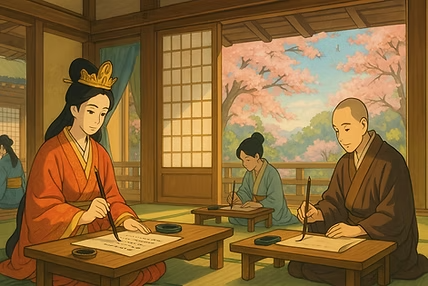
Japanese calligraphy, often referred to as shodō Japanese calligraphy, is not merely a traditional art form preserved in museums. It is a living cultural practice that continues to shape Japanese culture, influence contemporary Japanese artists, and attract global audiences fascinated by Japan and culture. At the core of this enduring vitality lies the cultural groundwork established during the reign of Empress Suiko (554–628).
This article revisits how calligraphy evolved under her influence and why its spiritual depth, diversity, and relevance continue to resonate today.
The Spiritual Foundation of Shodō in Empress Suiko’s Era
Buddhism and the Birth of Mindful Writing
During Empress Suiko’s reign, Buddhism became deeply integrated into Japanese society. Practices such as shakyō (sutra copying) transformed writing into a spiritual discipline. Characters were not written for speed or decoration but with sincerity, silence, and intention.
This belief—that calligraphy reflects the writer’s inner state—became a cornerstone of shodō Japanese calligraphy. The brush, ink (sumi), and paper worked together as tools of meditation, similar in philosophy to sumi-e, where minimal strokes express profound meaning.
Calligraphy as Inner Cultivation
In temples and at court, writing was regarded as a method of self-cultivation. The slow rhythm of grinding ink, controlling breath, and guiding the brush helped practitioners achieve mental clarity. These values later shaped Japanese aesthetics across tea ceremony, Zen thought, and visual arts.
The Rise of Diversity and Personal Expression
Kana and the Emergence of Women’s Calligraphy
After Empress Suiko’s era, Japanese calligraphy expanded beyond Chinese characters. The development of kana scripts allowed more personal, emotional expression—particularly among women in the Heian period. Letters, diaries, and poetry written in flowing kana marked a turning point in Japanese culture.
This era produced early female calligraphers and writers, establishing individuality and sensitivity as core elements of the art.
Multiple Functions, Multiple Styles
Calligraphy adapted to various needs: sutras, poetry, historical chronicles, and official records. Each purpose required different brush techniques and visual rhythms. This flexibility encouraged experimentation and laid the groundwork for the diversity seen in modern Japanese calligraphy and contemporary Japanese artists.
Why Japanese Calligraphy Still Matters Today
A Living Practice in Modern Life
Today, shodō Japanese calligraphy remains part of everyday life in Japan—taught in schools, practiced during New Year’s kakizome, and shared globally through exhibitions and social media. Zen temples continue to offer shakyō experiences to locals and international visitors alike.
In a fast-paced digital world, calligraphy offers rare moments of focus and stillness. This timeless appeal explains why it continues to captivate audiences interested in Japan and culture.
Global Interest in Sumi-e and Shodō
International workshops and galleries increasingly feature Japanese calligraphy alongside sumi-e. For many outside Japan, the art’s power lies in its ability to “communicate the heart beyond language,” making it accessible even without understanding the characters.
Empress Suiko’s Enduring Cultural Legacy
Perhaps Empress Suiko’s greatest contribution was fostering a society that valued spiritual cultivation and artistic sincerity. Under her influence, calligraphy became more than a technical skill—it became a vessel for emotion, identity, and mindfulness.
Modern Japanese calligraphy continues to embody these principles, connecting ancient values with contemporary expression.
Conclusion: A Tradition That Continues to Speak
The calligraphy cultivated during Empress Suiko’s reign remains a cultural treasure. Its blend of spirituality, diversity, and individuality ensures its relevance across centuries and borders. As more people seek authentic connections with Japanese culture, shodō and sumi-e stand as profound gateways into the Japanese spirit.
deepens your connection to Japanese tradition.
Explore and purchase hand-selected Japanese calligraphy artworks:
https://calligraphyartwork.stores.jp/
コメント