Introduction – Shodo Japanese Calligraphy, Buddhism, and Japanese Culture
If you are interested in Japanese culture, history, or shodo Japanese calligraphy, the name Soga no Umako (551–626) is worth remembering. He was a powerful aristocrat of the Asuka period, a turning point when Japan began to look outward to the Asian continent and inward to its own identity.
As the first great political supporter of Buddhism, Soga no Umako helped create the environment in which temples, sutra copying, and brush-written scripture could take root. Out of this world of incense, chanting, and hand-copied texts emerged the spiritual backbone of Japanese calligraphy — writing not only as information, but as devotion, discipline, and art.
This column traces how Buddhist temples founded under Soga’s patronage became early engines of literacy and calligraphic practice, quietly shaping what the world now recognizes as Japanese calligraphy and even influencing sumi e ink painting.
Soga no Umako in the Asuka Period
A Noble Who Backed a New Faith
In the 6th century, Japan’s elite families debated whether to accept Buddhism, a religion arriving from the Korean Peninsula and China. Soga no Umako became its most influential champion at court, arguing that this new teaching and its refined visual culture could enrich Japanese society.
His support was not only theological. Buddhism brought architecture, sculpture, ritual objects, and written sutras — all of which relied on literate monks and skilled brushwork. By backing Buddhism, Soga was also backing a new, text-centered way of organizing knowledge and governing a country.
From Local Beliefs to a Wider “Japan and Culture”
Before this period, the archipelago’s main religious framework was what we now call Shinto: local kami worship, rites, and court ritual. Buddhism introduced a universal vision — shared sutras, icons, and monastic rules that connected Japan to a larger “East Asian Buddhist world.”
To participate fully in that world, Japan needed more than faith. It needed script. Kanji characters, used for sutras and diplomatic correspondence, became essential tools for recording law, doctrine, and political thought. That is where Soga’s temple projects became so crucial for the future of Japanese calligraphy.
Buddhist Temples as the Cradle of a Writing Tradition
Asuka-dera: The First Full-Scale Buddhist Temple
One of Soga no Umako’s most important achievements was initiating the construction of Asuka-dera (also known as Hōkō-ji) in the late 6th century. Many historians regard it as Japan’s first full-scale Buddhist temple, built soon after Buddhism was formally introduced from the continent.
Asuka-dera was more than a place to pray. It concentrated artisans, monks, and scribes, and it housed imported icons and scriptures. The temple functioned as a cultural hub where Chinese characters, Buddhist images, and continental building techniques were studied side by side. In this setting, brush, ink, and inkstone were as necessary as statues and bells.
Shakyō – Sutra Copying as Meditation in Ink
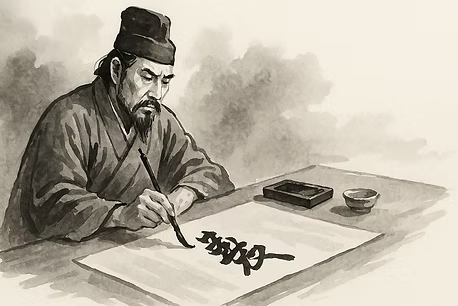
As Buddhism spread, so did the need to reproduce its teachings accurately. This led to the rise of shakyō, or sutra copying: the practice of tracing or writing sutras by hand with brush and sumi ink.
Shakyō was — and remains — more than simple duplication. Each character is written slowly, in silence, often after a short period of meditation. In classical practice, the copier purifies their hands, sits with a straight back, and treats the sheet of paper almost as an altar.
In this environment, something key to shodo Japanese calligraphy was born:
- The idea that line quality reflects inner state.
- The understanding that repetitive practice refines both technique and mind.
- The sense that brush, ink, and paper connect body, thought, and belief.
From the perspective of Japanese culture, shakyō turned the written character into a bridge between everyday life and the sacred — a sensibility that later shaped shodo and even sumi e ink painting.
Calligraphy as a Mirror of the Heart
“Sho wa kokoro no kagami” – Calligraphy as Inner Landscape
Over centuries, Japanese artists came to express a simple truth: “Sho wa kokoro no kagami” (“Calligraphy is a mirror of the heart”) and the closely related saying “Sho wa hito nari” (“Calligraphy reveals the person”).
You can already see the roots of this idea in Asuka-period sutra copying. When a monk’s mind wanders, the lines become shaky; when breath and posture settle, the characters stabilize and flow. In this sense, calligraphy is not just a surface style — it is a trace of breathing, concentration, and intention.
Modern students of shodo Japanese calligraphy still experience this. A single sheet of washi can reveal whether they approached the work as a rushed task or as a moment of mindfulness. For many Japanese artists today, the brush remains one of the most direct tools for visualizing the inner self.
From Correct Form to Expressive Shodo
Early sutra copying focused on correct form and legibility, often in kaisho (standard script). But over time, the same spiritual seriousness was applied to more flowing scripts and to works that were less about reading and more about feeling.
This gradual shift — from strictly functional writing to writing that also carries mood, tempo, and atmosphere — is one of the key bridges from temple script to what we now call shodo and, in painting, sumi e, where ink, water, and empty space tell a story as vivid as any text.
Kanji, Temples, and the Spread of Writing in Japan
Kanji on Wood, Stone, and Paper
Under patrons like Soga no Umako, kanji began to appear in many places:
- inscriptions at temples
- dedicatory texts on statues
- official court documents
- copied sutras stored in temple archives
Every one of these contexts required people who could handle brush and sumi ink with accuracy and care. As their numbers grew, so did the familiarity of ordinary people with characters, even if they could not yet read them fluently.
In other words, Buddhism and its temples made written form visible throughout the landscape — an important step toward a culture in which writing and visual rhythm would be central to Japanese identity.
Towards a Distinctively Japanese Calligraphy
Although the characters themselves were Chinese, the way they were spaced, balanced, and combined began to take on a Japanese flavor. Different temples favored slightly different styles; individual scribes developed their own preferences for stroke thickness and contrast.
Over long stretches of time, this diversity laid the groundwork for the uniquely Japanese aesthetics of shodo Japanese calligraphy:
- sensitivity to ma (negative space)
- preference for visible brush texture
- valuing of slightly imperfect, “alive” lines over mechanical regularity
This same sensibility later fed into sumi e and contemporary Japanese artist practices, where a single bold stroke can evoke landscape, emotion, or season without a single word.
Temples as Cultural and Educational Hubs
Training Grounds for Early Japanese Artists
The temples associated with Soga no Umako did not only serve monks. They attracted artisans, carvers, painters, and scribes who supported ritual life and temple construction. In these workshops, writing, design, and carving were closely linked.
Copying sutras trained eye and hand. Designing inscriptions for pillars or plaques blurred the line between lettering and layout. In this sense, the temple was one of the first places in Japan where we can glimpse a prototype of the “Japanese artist” working across text, image, and space.
Preserving Knowledge for Future Generations
Temples also became libraries. They housed the sutras that had been copied, stored records of donations, and maintained chronicles. This archival role preserved early examples of calligraphy that later generations could study, just as shodo students today look back to classical models when practicing.
Without this temple-based system of preservation, much of the visual history that underpins Japan and culture as we understand it today would have been lost.
The Living Legacy of Soga no Umako in Today’s Shodo
From Shakyō to Modern Experiences
The spiritual DNA of Soga no Umako’s temple culture is still alive. Today, visitors to Japan can try shakyō at temples in Kyoto, Nara, Tokyo, and other regions, often as part of meditation or Zen experiences.
Workshops that combine shodo Japanese calligraphy, sutra copying, and even simple sumi e painting are increasingly popular among people seeking a slower, more grounded form of Japanese culture. Some contemporary studios and cafés abroad now host sutra-copying or calligraphy sessions, showing how this once court-centered practice has become global.
Why Soga no Umako Matters for Japanese Calligraphy
Soga no Umako is often remembered as a political figure and as a patron of Buddhism. But seen through the lens of Japanese calligraphy, his significance becomes even clearer:
- By backing Buddhism, he made temples into engines of literacy.
- By building Asuka-dera, he created a space where scripture, sculpture, and script could grow together.
- By accepting kanji into the fabric of governance and faith, he helped set Japan on the path toward its own calligraphic and pictorial styles.
In short, the world of brush and ink that later flourished in Japanese calligraphy and sumi e owes much to the quiet decisions of this early statesman.
Conclusion – Quiet Temples, Powerful Lines
In the Buddhist temples fostered by Soga no Umako, writing shifted from a practical tool to a vehicle for spiritual practice, memory, and art. Every carefully copied character of a sutra, every inscription on a temple beam, helped to build the foundation of shodo Japanese calligraphy as we know it today.
To truly understand Japanese calligraphy is to feel this layered history: the meeting of kanji and Buddhism, the patience of monks at their desks, and the vision of leaders who believed that adopting new ideas could strengthen their land.
When you watch a Japanese artist lay down a single black stroke on white washi, you are seeing more than design. You are glimpsing a tradition that began in incense-filled halls, under the patronage of people like Soga no Umako — a tradition where writing, faith, and Japanese culture are inseparable.
deepens your connection to Japanese tradition.
Explore and purchase hand-selected Japanese calligraphy artworks:
https://calligraphyartwork.stores.jp/
コメント