February 22 is widely known in Japan as Cat Day (Neko no Hi). The date “2-2-2” can be read as nyan-nyan-nyan, a playful echo of a cat’s meow in Japanese—and the day itself was established in 1987 by a Cat Day committee after polling cat lovers.
As Cat Day approaches, Japan turns into a small, warm festival of felines—on the streets, in shops, and across social media. But what strikes me most is how the celebration has matured: it’s not only about “cute cats,” but also about responsibility, coexistence, and the idea that a life shared with an animal is something to protect.
I’ve lived with cats. One of them was “my cat” from the beginning. The other connection arrived later, unexpectedly: a stray cat that had grown comfortable around me came one day—and brought her kitten with her. That moment changed the way I see trust.
Cats don’t promise with words. They negotiate trust with distance and silence. They come close, stop, step back, and then come close again. That rhythm—hesitation followed by decision—reminds me of a brushstroke in calligraphy. In shodo, one line can carry an entire state of mind.
The Maneki-neko: A Japanese Culture Symbol that “Invites” Good Fortune
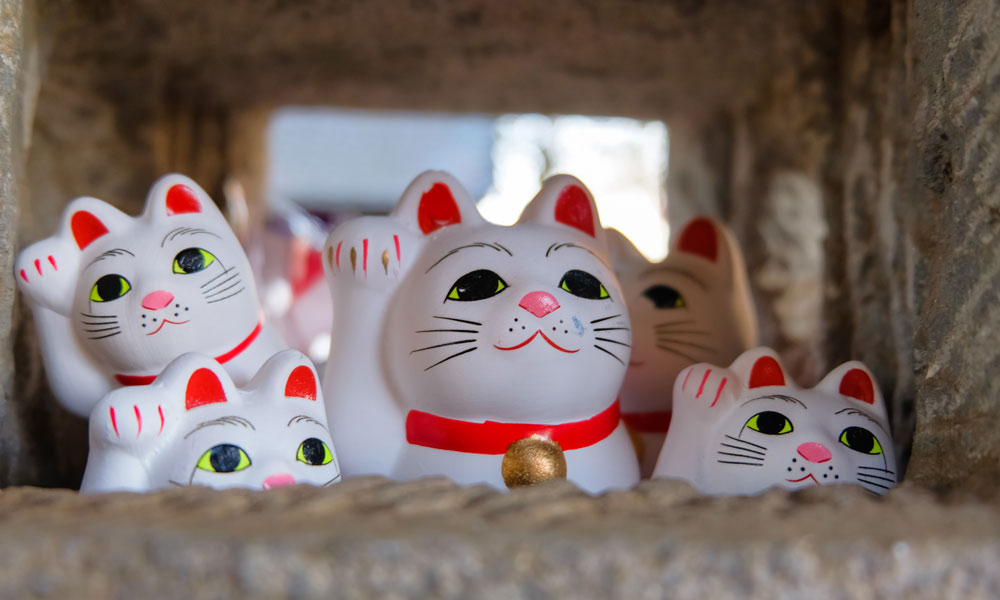
Japan also has the maneki-neko—the beckoning cat—often placed near entrances to invite luck, customers, or prosperity.
What I love about the maneki-neko is its humility. It doesn’t grab or shout. It simply raises a paw, quietly inviting good things to come closer. This subtle “invitation” reflects something deeply rooted in Japanese culture: the belief that space, timing, and restraint can be powerful.
That idea leads naturally to calligraphy—because in calligraphy, what you don’t write matters as much as what you do.
Shodo Japanese Calligraphy: Writing “Presence” with Brush and Ink
Shodo is a traditional Japanese art of writing characters using a brush and ink—not only to form beautiful kanji or kana, but to express your inner state through movement and balance.
In shodo, a line is not simply a line. Once the brush touches paper, there is no true “undo.” You commit. You breathe. You place the stroke. And the white space around it becomes part of the composition—like silence in music.
This sensibility is closely connected to sumi-e (also written as sumi e): the world of ink painting, where black ink holds countless shades, and emptiness is never “nothing.” It’s a living space where meaning can appear.
A Cat’s Walk Teaches Brush Control Better Than You’d Expect
Watching a cat closely, you notice something: cats are masters of switching modes.
They are still—completely still—and then they move in a single, clean decision. That “stillness before action” is exactly what the brush requires. If you keep moving without pause, your stroke becomes cloudy. If you stop with intention, the ink breathes.
The day that stray cat brought her kitten, I felt two emotions in the air at once: welcome and caution. If I had rushed forward, everything would have shattered. So I chose a different skill: I waited.
That way of waiting still lives in my calligraphy today. Because blank space is not empty. It’s where the next stroke is born.
A Cat Day Ritual: Write One Character in Three Minutes
You don’t need special tools to try this. If you have a brush and ink, wonderful. If not, a pen is enough. The point is to focus on one character—not perfection.
- Take one calm breath.
- Choose one character that matches what you need right now (examples: “福” fortune, “和” harmony, “静” stillness).
- Don’t aim for “beautiful.” Aim for honest—place each stroke carefully.
- When you finish, look not only at the ink, but at the space around it.
In Japan, writing can be a way to shape intention—quietly, without performance. On February 22, Cat Day can become your own small moment to reset: inspired by the cat’s stillness, and the maneki-neko’s gentle invitation.
If you’re curious about japan and culture, this is one of the simplest doorways in: a single character, a single breath, and the courage to leave space.
Deepen your connection to Japanese tradition.
- Shop hand-selected Japanese calligraphy artworks: https://calligraphyartwork.stores.jp/


コメント