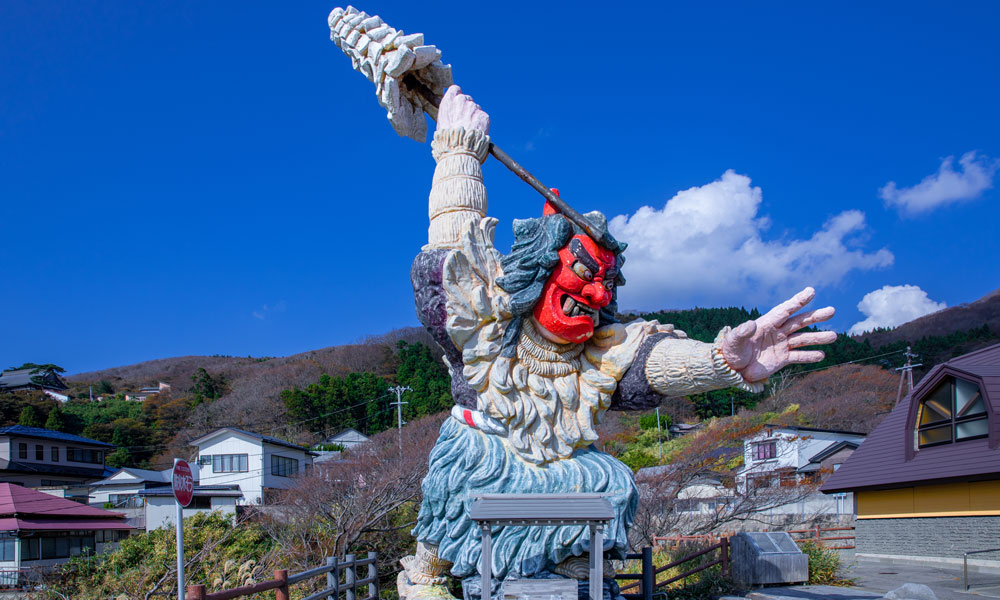
Why I stopped treating Oni as “just a villain”
In Japan, Oni often appears as the one you drive away—especially around Setsubun, when people shout “Oni out!” and throw beans. For a long time, that was my entire image of Oni: loud, scary, and simple.
But the first time I wrote the kanji 鬼 with real intent, it wasn’t about fear.
I remember practicing what I thought were “strong” strokes—bold lines, fast movement, no hesitation. Yet something felt off. I could make the character look confident, but it didn’t feel honest. The brush was loud, but the meaning was shallow.
That’s when Oni came to mind—not as a monster outside the door, but as a name for what I avoid naming inside myself.
Now, when I write 鬼 in Japanese calligraphy (Shodo), I’m not trying to decorate fear. I’m giving shape to something vague so it can be seen clearly—and placed at a proper distance.
What Oni can represent (beyond “demon”)
In English, Oni is often translated as “demon” or “ogre.” That translation is not wrong, but it can flatten the feeling. Oni can symbolize fear, yes—but also boundaries and control:
- what stays outside vs. what you allow inside
- what you reject vs. what you accept and manage
- what you ignore vs. what you finally face
For me, Oni is a character that turns discomfort into something visible. And once something has a shape, it becomes easier to handle.
The kanji 鬼 has weight—and that’s why it works as wall art
In calligraphy, some characters feel light, like air. Others feel heavy, like stone. 鬼 is heavy.
Its structure is compact and dense. Even people who don’t read Japanese often feel that density immediately. That’s why Oni works well as a single-kanji Shodo piece: it can stand alone, and the white space around it becomes part of the meaning.
A reminder I often share with clients:
Meaning matters—but shape is what your body remembers.
With 鬼, the shape stays with you.
How brushwork changes the “face” of Oni
The same character can become completely different depending on brush choice, ink, speed, and negative space. When I design an Oni piece, I usually choose one of these directions:
1) The quiet Oni — restrained, reflective
- controlled pressure
- clean edges
- generous white space
This Oni doesn’t shout. It watches. It’s for people who want a calm reminder, not an aggressive symbol.
2) The storm Oni — raw, energetic, alive
- heavier ink
- visible speed changes
- intentional texture (dry brush / slight roughness)
This version isn’t “evil.” It’s commitment—I will face what I’ve been avoiding.
3) The protective Oni — grounded, boundary-making
- stable center of gravity
- a composition that feels “closed” and complete
Some people choose Oni as a guardian-like boundary: a sign that says, this space is protected.
Where Oni fits best in your space
If you’re considering Japanese calligraphy wall art featuring Oni (鬼), place it where its role makes sense:
- Workspace / studio: a focus symbol that keeps you honest
- Entryway: a boundary between outside noise and inner peace
- Gift: meaningful only when the recipient welcomes the theme
If you want it to feel welcoming rather than intense, I recommend the “quiet Oni” approach—with breathing room in the composition.
If you commission an Oni piece, decide these 5 things first
When someone commissions Oni kanji calligraphy, I ask a few simple questions. Answering them turns “a character” into your character:
- Should Oni feel frightening, humorous, or calm?
- Is this about removing something—or accepting and managing it?
- Where will you display it (light, wall color, viewing distance)?
- Do you prefer deep black ink, or softer gray tones?
- Do you want only 鬼, or a short phrase that frames it?
The goal isn’t to decorate fear.
The goal is to give Oni the right role in your life.
FAQ
Q1. What does Oni mean in Japanese?
A. Oni is often portrayed as a fearsome being, but it can also symbolize what we want to keep outside, confront, or name clearly.
Q2. Is the kanji 鬼 too negative to display?
A. Not necessarily. The mood depends on the calligraphy style. A restrained 鬼 can feel reflective and grounding.
Q3. Can Oni be meaningful as a gift?
A. Yes—when the recipient welcomes the theme. If you’re unsure, a gentler kanji or phrase may be a better choice.
Q4. How does this relate to Setsubun?
A. Setsubun is a cultural doorway into Oni, but the deeper meaning of the character can be personal and year-round.
Suggested internal links(サイト内導線)
- Learn basics: Japanese Calligraphy (Shodo) Guide →
/en/japanese-calligraphy/ - Request a piece: Commission →
/en/commission/ - Browse works: Artworks →
/en/artworks/
Deepen your connection to Japanese tradition.
Shop: https://calligraphyartwork.stores.jp/ (Original calligraphy works)
コメント