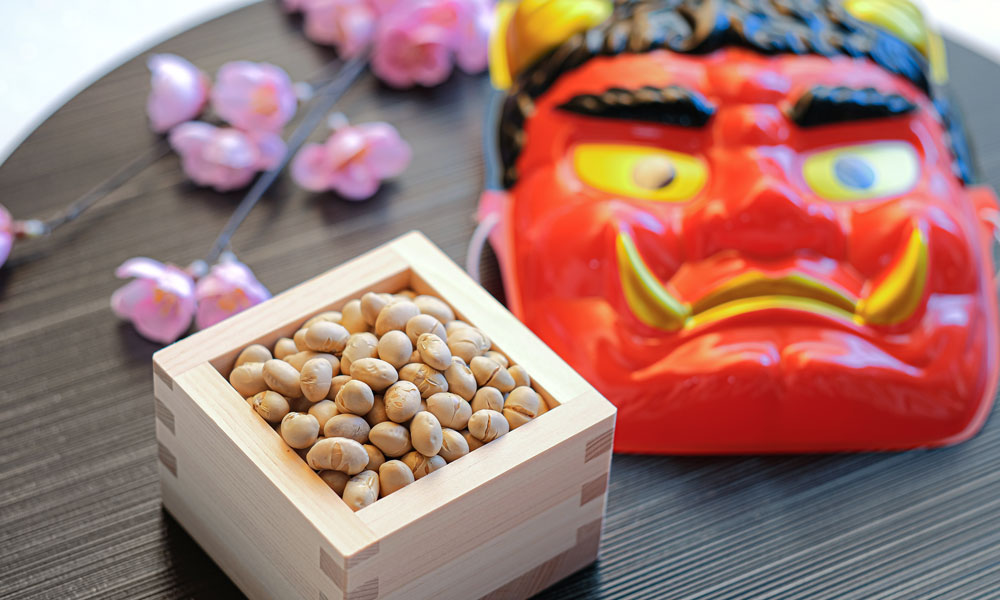
Why this phrase belongs on paper, not only in the air
“Oni wa soto, fuku wa uchi” is loud when spoken. It’s meant to cut through the room.
But on paper, it becomes delicate. A tiny change in spacing or pressure can turn a strong chant into a messy page—or into a piece that feels calm, clear, and complete.
As a writer and artist who has worked with the brush for decades, I’ve learned one principle: short phrases demand structure. The fewer the words, the more every stroke matters.
This article shows how to turn the Setsubun chant into Japanese calligraphy you can actually display—without overcomplicating it.
If you prepare on January 31, you can write with a clear mind
Setsubun arrives quickly. If you prepare your layout and intention ahead of time, the day itself becomes simple: you just write.
Less hesitation means cleaner strokes.
Design first: three choices that make the piece look intentional
Before you touch ink, choose your structure. This is where “a chant” becomes “art.”
Decide what your “oni” represents (privately)
You don’t have to explain it. You don’t even have to name it out loud.
But decide, privately: what is your “oni” this year?
Rushing. Lingering anxiety. Avoidance. Scattered plans.
Once you decide, your strokes stop being decoration. They become intentional.
Two lines or one line
If you want the safest, most elegant composition, use two lines:
Oni wa soto
Fuku wa uchi
Two lines naturally show movement: out, then in.
One line can work, but only if you can control spacing and pause. If it feels cramped, return to two lines. In calligraphy, restraint is strength.
Negative space as the doorway for good fortune
Negative space isn’t emptiness. It’s invitation.
If “good fortune” is entering, the page needs a place for it to arrive.
Avoid heavy decoration. Let the white paper do its quiet work.
Japanese calligraphy technique: keep the energy, remove the noise
A chant has speed. A finished piece needs clarity. Your job is to keep the energy but remove the noise.
Make “oni” heavy, make “fuku” light
Even with the same ink, you can change weight and feeling.
For “oni” (the part you cast out):
- deeper entry
- thicker line
- stronger stops
For “fuku” (the part you welcome):
- slightly finer line
- longer release
- more air in the stroke
The viewer will feel the contrast without explanation.
Use “out / in” to create direction
Think of “out” and “in” as arrows on the page.
For “out,” let the finishing sweep open outward—so the eye leaves the page.
For “in,” bring the final stop back toward the center—so the eye returns home.
In two lines, keep the first line firmer and the second line calmer.
That alone makes the ritual visible.
Finish like artwork: signature and seal as the final breath
A seal or signature is not an accessory. It’s a period.
If it becomes the loudest element, the phrase loses its center.
Keep it small. Place it late. Let the words remain the main voice.
Display it briefly: a one-night piece can be powerful
A seasonal piece doesn’t have to live on the wall forever.
Sometimes, the strongest choice is a short display.
Write after the ritual—when the room turns quiet
After the bean-throwing moment, the room often turns strangely quiet.
That quiet is the perfect time to write.
Try this:
- Do a small Setsubun ritual (even quietly at home)
- Before cleaning, place paper on the table
- Breathe for ten seconds
- Write once—don’t “fix” it
If you keep rewriting, the chant can turn into a flat explanation. One decisive pass often feels more alive.
Don’t “carry it over”: treat the sheet like a seasonal boundary
When you clean after Setsubun, you’re not only removing beans—you’re resetting the room.
Treat the sheet the same way: display it overnight, then file it away.
Next year, write again. Over time, you’ll see not just technique, but the shape of your seasons.
A seasonal mindset: crossing a threshold with a simple act
Setsubun is about crossing a boundary: expel what weighs you down, welcome what steadies you.
Calligraphy makes that boundary visible.
Layered meanings are part of Japanese culture
One action can hold several meanings at once.
That layering is part of why seasonal customs stay alive: they can be practical, emotional, and symbolic at the same time.
Your piece can do that too—if you leave space for it.
Closing: the same words, a different year, a different piece
The phrase stays the same. Your year doesn’t.
So let your strokes change.
Write it once. Display it briefly. Keep it.
Next year, compare. The page becomes a quiet record of how you moved through time.
Deepen your connection to Japanese tradition.
Explore and purchase hand-selected Japanese calligraphy artworks (Shop):
https://calligraphyartwork.stores.jp/


コメント